
The biotechnology innovation ecosystem is undergoing a quiet revolution, driven by scientific advancements, a recognised market need to shift towards sustainability and resilience, and increasing regulatory pressure. Additionally, recent breakthroughs in AI and engineering have accelerated the development and scale-up of biotechnology, making it possible to produce sustainable, bio-based solutions in wider applications and industries, including food and beverage, cosmetics and beauty, pharmaceuticals and chemicals.
How can companies in these sectors understand where “clean biotechnology” is heading, and act early enough to capture the opportunity?
For the food and beverage sector, there is a clear potential for clean biotechnology applications to reshape the food and beverage value chains. Brand owners and manufacturers are under growing pressure to reduce emissions, improve resource efficiency, decarbonise upstream suppliers, manage supply chain risks and respond to changing consumer preferences and regulations, putting pressure on companies and their suppliers to rethink materials, sourcing, waste and lifecycle impacts.
Regulation is also creating clearer entry points for clean biotechnology across the food and beverage value chain. For example, the PFAS restrictions for food packaging from the Packaging and Packaging Waste Regulation (PPWR) are increasing pressure on fossil-based plastics and conventional barrier materials, accelerating interest in bio-based, recyclable and PFAS-free alternatives. The EU Deforestation Regulation is also increasing scrutiny on agricultural commodities such as palm oil, cocoa, soy, coffee, cattle products and timber, creating demand for stronger traceability and lower-impact sourcing. These shifts are making clean biotechnology solutions such as biodegradable packaging, PFAS-free coatings, precision fermentation-derived ingredients, novel farming systems, waste-derived feedstocks and biosensor-based tracing increasingly relevant to food and beverage brand owners and their suppliers.
Clean biotechnology will not solve all of these challenges on its own. However, it offers a growing set of tools that can help companies respond more strategically. The question for food and beverage leaders is no longer whether clean biotechnology will matter, but where it will create advantage first, and how to de-risk early moves. Some solutions are now mature enough to support near-term pilots and operational value creation, particularly in water, waste, process efficiency and selected food packaging applications. At the same time, a growing wave of disruptive biotechnology innovations is emerging, such as novel ingredients, fermentation-based production, biological sensing and waste-to-value technologies, with the potential to unlock longer-term, transformational change across the sector.
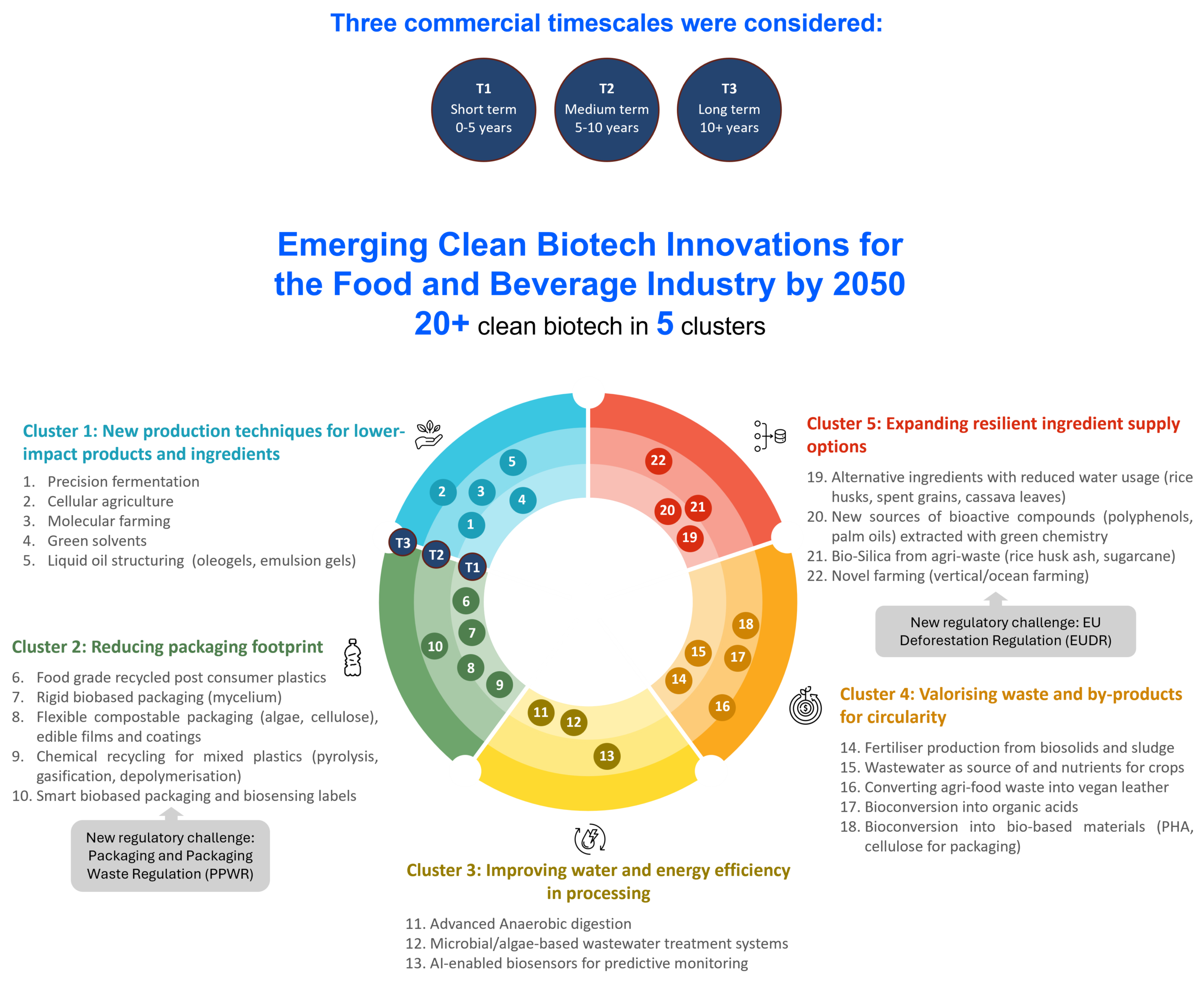
Recognising this transition, CLT has analysed the emerging clean biotechnology landscapes that are likely to impact the future of the food and beverage sector. The result is identifying 20+ key innovations in 5 clusters relevant to the food and beverage sector through to 2050. The analysis revealed both opportunities and challenges: clean biotechnology has the potential to address sustainability and operational challenges that have been difficult to solve through conventional approaches, but companies need to identify where it matters first, and how early they should act in near-term pilots, medium-term capability building and longer-term strategic planning.
In this blog post we will:
- Define what is “Clean Biotechnology”
- Introduce our analysis of 20+ technologies in 5 clean biotechnology innovation clusters relevant to address the challenges in the food and beverage sector
- Identify near-term vs longer-term opportunities for corporates
- Suggest practical actions brand owners and manufacturers can take to capture the opportunity
What is “Clean Biotechnology”?
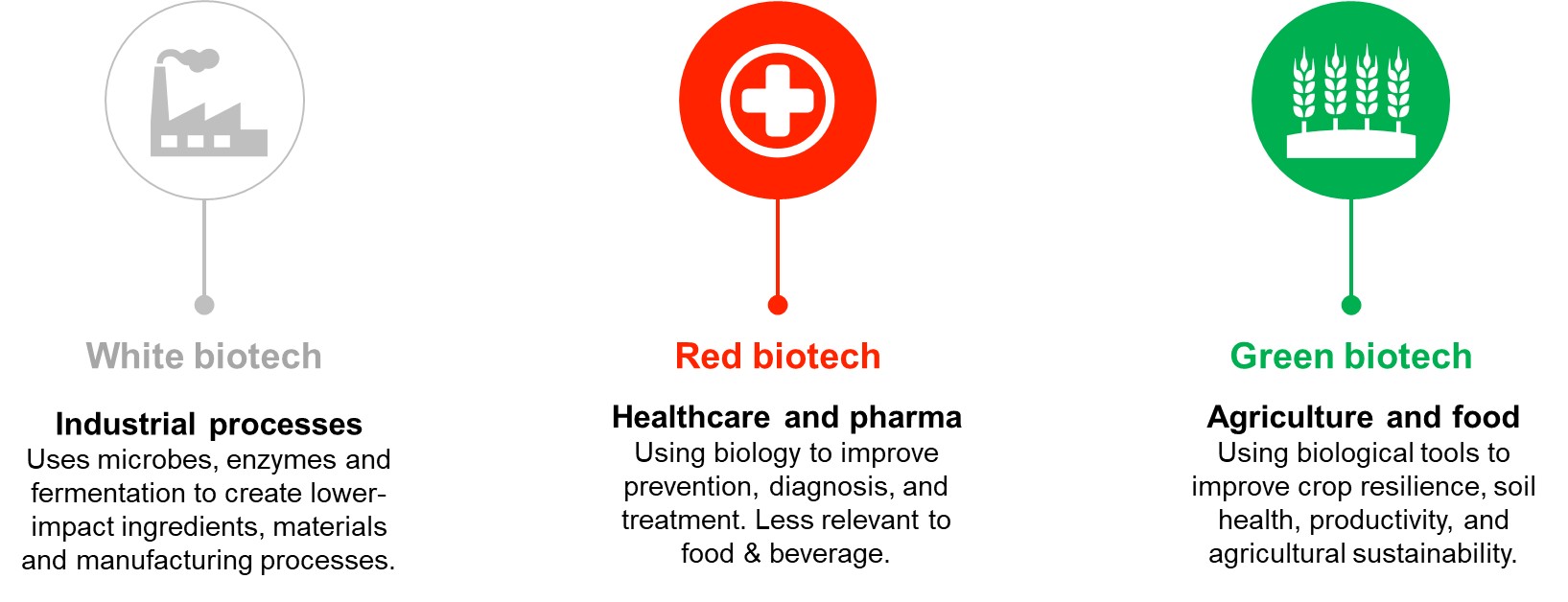
At CLT, we define clean biotechnology as the use of biological systems to develop lower-impact ingredients, materials and industrial processes, with particular relevance in industrial (white) biotechnology and sustainability-relevant applications of agri-food (green) biotechnology.
What sustainability challenges can clean biotechnology address for the food and beverage sector?
InIn the next five to ten years, clean biotechnology has the potential to help food and beverage companies tackle decarbonisation hotspots, improve resource efficiency, and access long-term sustainable value.
Our research first identified all the clean biotechnology innovations with relevance to the food and beverage sector. These technologies were then grouped into five clusters, each aligned to a core sustainability challenge:
- New production techniques for lower-impact products and ingredients by developing bio-based alternatives to carbon-intensive ingredients, processing aids or functional inputs, while also opening new routes to flavour, aroma and product differentiation.
- Reducing packaging footprint by integrating bio-based, recyclable or biodegradable materials that could reduce reliance on fossil-based inputs and, in selected formats, lower the lifecycle impact of packaging.
- Improving water and energy efficiency in processing through bio-based filtration, nutrient recovery and process optimisation that can reduce freshwater demand, lower wastewater load and enable wastewater upcycling.Biogas generation, enzyme-enabled process optimisation and advanced biosensing can reduce heat demand, improve yields and increase the efficiency of energy-intensive operations.
- Valorising waste and by-products by converting spent grain, yeast, wastewater residues and other side streams into higher-value materials, ingredients or bio-based products.
- Expanding resilient ingredient supply options through fermentation-based production, controlled-environment systems or recovery from waste streams, helping reduce exposure to climate-related agricultural disruption.
To assess commercial relevance, we considered three broad time horizons: short term, from zero to five years; medium term, from five to ten years; and long term, beyond ten years. This enabled us to map the clean biotechnology landscape for the food and beverage sector, identifying where companies can act now, where targeted pilots may be needed, and where longer-term capability building could create strategic advantage.
Near-term vs emerging opportunities for brand owners and manufacturers
Mapping the clean biotechnology landscape is only the first step. For brand owners and manufacturers, the more important question is where to act now, where to run targeted pilots, and where to monitor or build capability for longer-term strategic advantage.
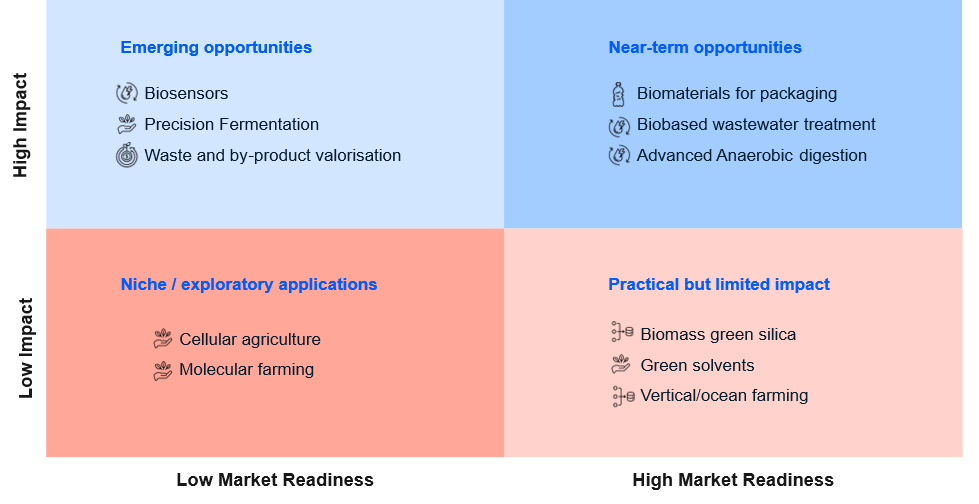
When assessed against environmental impact and commercial readiness, three areas stand out as nearer-term opportunities for food and beverage companies: packaging biomaterials, bio-based wastewater treatment and advanced anaerobic digestion. These technologies have clearer routes to piloting, partnership or deployment because they build on existing technical pathways and align closely with operational pain points already facing food and beverage companies.
More disruptive opportunities, such as AI-enabled biosensors, precision fermentation and waste-stream bioconversion, also show strong potential. While these technologies are already being applied in selected use cases, broader adoption across the food and beverage sector will depend on further validation, targeted partner engagement and clear routes to scale.
Near-term Opportunities
The technologies below represent actionable opportunities for Food & Beverage companies with clearer routes to pilot, partner, or deploy.
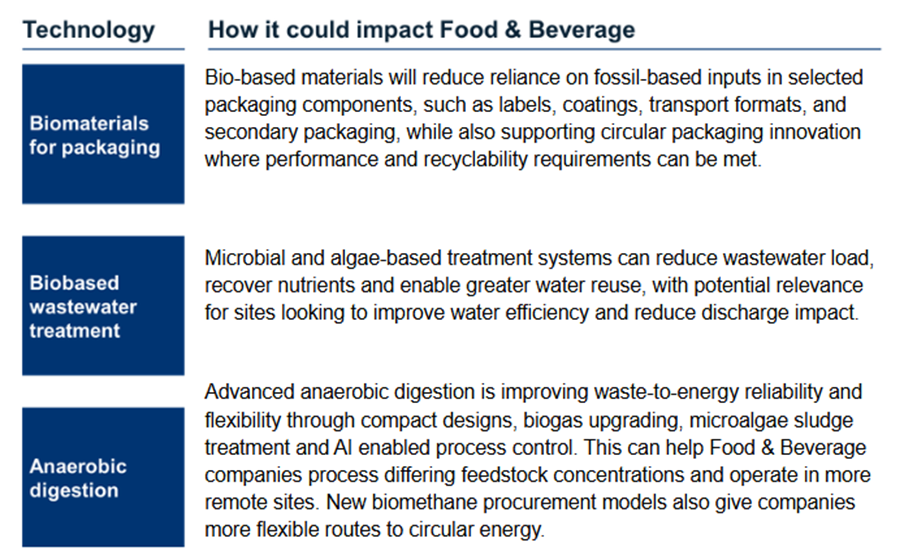
Emerging Opportunities
These technologies have strong disruptive potential but may require further validation, partner scouting or targeted pilots. Successful early engagement could help Food & Beverage companies build first-mover advantage.
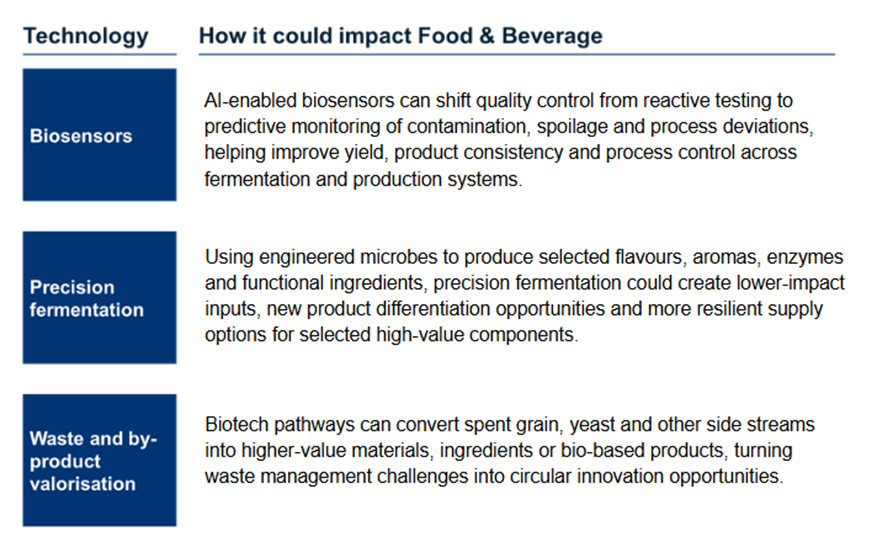
Together, these opportunities suggest that clean biotechnology should not be treated as a distant or speculative field. Some technologies are already close enough to commercial application to justify targeted action today, while others require active tracking, ecosystem engagement and capability building to capture future value.
Converting clean biotechnology innovation into targeted R&D, partnership and growth opportunities
As clean biotechnology continues to mature, the companies best placed to benefit will be those that can identify relevant opportunities early, engage the right partners and turn emerging innovation into practical routes to deployment.
For corporates, the challenge is not simply finding emerging clean biotechnology solutions. It is understanding which technologies are relevant to their specific sustainability priorities, which are mature enough to engage with, and which partners have the credibility and capability to support commercial progress.
At CLT, we see four steps as critical to converting innovation into commercial value: defining the right innovation priorities, scouting relevant technologies and partners, designing the right collaboration model, and executing programmes that can move from pilot to scale.
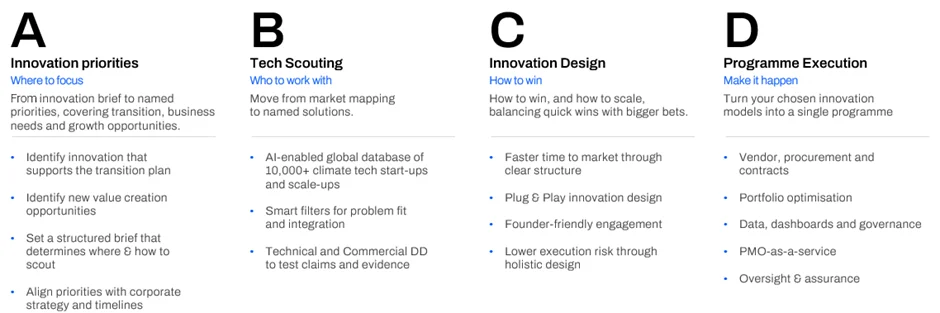
CLT supports companies across this pathway by combining market insight, technology assessment and innovation ecosystem engagement. The aim is to activate collaborations that address priority challenges, create mutual value and provide a credible route to deployment.
Food and beverage manufacturers and brand owners that capture value from clean biotechnology will be those that move early, choose selectively and partner effectively. The right innovation partnerships can help companies access solutions at the right maturity level, through the right commercial model, turning sustainability ambition into practical routes for piloting, deployment and measurable growth.
CLT would welcome the opportunity to discuss how clean biotechnology could support your company’s wider cleantech innovation priorities. Contact us for more information
Contact
Ben Lynch, Chief Commercial Officer

Written by